Volunteer sinks in Baffin Bay
The North WaterThe sinking of the Volunteer is not simply a maritime disaster: the evidence presents it as the intended outcome of an insurance scheme, designed to make deliberate destruction appear to be an unavoidable encounter with Arctic ice. The plan grows out of a failing whaling business, depends on the timing and appearance of the loss, and ultimately leaves Patrick Sumner with an account that its surviving beneficiary has every reason to discredit.
Commercial decline and the insurance incentive
Arthur Brownlee initially insists that he can still fill the ship’s hold, but Baxter argues that the conditions of the trade have changed. He contrasts the earlier days, when a boat and harpoon could bring wealth, with a present in which success requires expensive steam power, harpoon guns, and luck—and even then a ship may return empty. The shrinking prospects of ordinary whaling make the promised alternative especially potent: Baxter shows Brownlee papers setting out £12,000 divided three ways, a sum he says exceeds what Brownlee could expect to earn from whales.
Brownlee’s response is wary rather than enthusiastic. He makes Campbell’s presence at the necessary moment a condition of the arrangement and says he will turn the ship home if Campbell is not there when needed. Baxter, meanwhile, describes money as a force that finds its own route, even when people would prefer to block it. His language makes the scheme sound both irresistible and impersonal, although the papers and the discussions show people arranging its terms.
The voyage also carries the appearance of a real commercial expedition. The crew sails north from Lerwick through rough weather, reaches the seal pack near Jan Mayen Island, and begins hunting. Brownlee counts the skins and calculates their possible oil yield and market value. Later, in the North Water, the crew kills a whale that Brownlee estimates could yield ten tons of oil and more than half a ton of whalebone, worth close to £900 if prices hold. The work and its returns provide a genuine commercial setting for the voyage, even as the insurance arrangement redirects attention from the catch to the ship itself.
Concealing the arrangement in the Arctic
The connection with Campbell is meant to remain hidden until the time is right. Campbell waits aboard the Hastings beyond Disko Island, while the two ships avoid meeting or communicating prematurely. The underwriters are described as alert to signs of conspiracy, and the Volunteer’s unusually heavy insurance already makes it suspicious. The plan therefore depends not only on causing a loss but on controlling when the ships are seen together and how the loss will appear.
Campbell makes that distinction explicit when he warns that the whales are of little importance beside the opportunity to sink the Volunteer convincingly. The timing must avoid attracting questions from the underwriters; waiting too long, however, risks trapping Campbell himself in the ice. The scheme thus turns on a narrow practical calculation: the ship must be lost at a moment when the surrounding conditions can plausibly explain what happened.
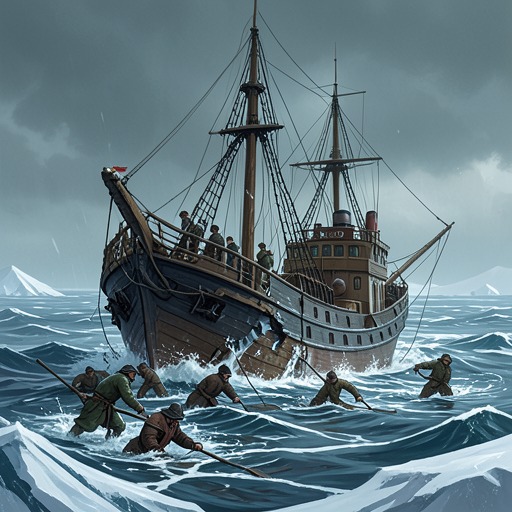
Those conditions are real. As the ships proceed through Lancaster Sound, a change in the wind sets drifting pack ice moving toward them. Cavendish orders the crew to cut an ice dock for protection. They work with ice saws, ropes, pulleys, and boarding pikes, cutting through ice six feet thick to make a dock with sides two hundred feet long. The labor gives the ship an apparent response to a genuine hazard. Yet Cavendish’s later remark that he can sink the Volunteer if it does not sink then, followed by his observation that a later sinking would not look as convincing because they have built the dock, joins the protective preparations to the plan’s concern with appearances.
The planned loss and its cover story
The evidence establishes the intention to make the Volunteer’s destruction look like an ice casualty, but does not narrate the actual moment of sinking in these scenes. Its significance emerges through the planning beforehand and the competing explanations afterward. Much later, Baxter summarizes the account that is supposed to be available to the waiting world: both ships lost to ice, with Sumner miraculously rescued by passing Yaks. Sumner says he will not tell that story anytime soon, refusing to accept Baxter’s framing as the account he must give.
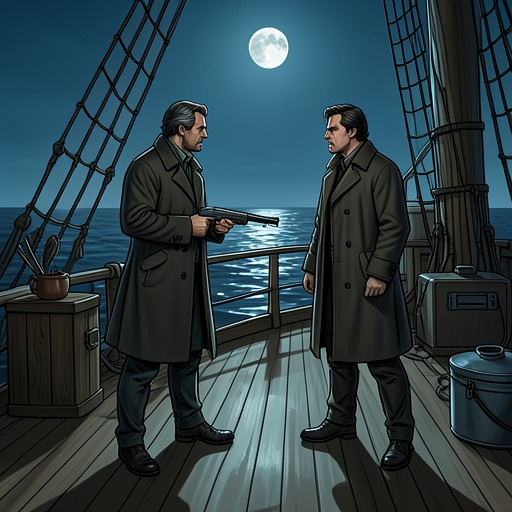
In a subsequent confrontation, Sumner lays out his understanding: Baxter had Cavendish sink the Volunteer; Drax and Sumner were the only men who might have known or guessed what had happened; and a sequence in which Drax shot Sumner and Stevens then shot Drax would have left the matter apparently settled. Sumner calls the outcome a misfire. Baxter denies that his reconstruction is right, but does not meet it with an account that resolves the conflict. Instead, he stresses that two men are dead, one by Sumner’s hand, and that Sumner needs his assistance.
Exposure, silence, and consequence
Baxter turns the danger of disclosure back on Sumner. He argues that Sumner’s uncertain background and time in India would invite scrutiny, warns that the magistrate may not believe his explanation, and points out that the ships are already lost and the dead cannot return. He then offers fifty guineas for Sumner to put down his gun, leave the house, and begin again. The offer makes the aftermath part of the scheme’s concealment: money is again presented as a way to close off one route and open another, this time by buying the surviving witness’s silence.
The sinking therefore carries two linked consequences. It destroys the Volunteer and helps make a fabricated account of accidental loss plausible, while also placing the truth in the hands of a survivor whom Baxter can portray as legally and socially unreliable. The contrast between the crew’s visible labor against moving ice and the commercial calculation behind the ship’s intended loss gives the event its central irony: the Arctic danger is genuine, but the plan depends on making that genuine danger serve as cover for human design.